V-LITE® Polycarbonate Prism Sheet
Multi-UV sheeting with grade designations stating profile, colour, light transmission and properties.
What the V-LITE Polycarbonate Prism Sheet is
A polycarbonate sheet supplied with a repeating prism pattern worked into its face, in 4 thicknesses and 3 colours. Here is what is published, what it is specified for, and what still has to be confirmed before you order.
The Polycarbonate Prism Sheet is part of the V-LITE® range made by Adinath Poly Plast Pvt. Ltd. in Indore, Madhya Pradesh. It is ordered against product code VL-PC-PR and is published in 4 mm, 6 mm, 8 mm and 10 mm thicknesses, 1220 mm and 2100 mm widths and Bronze, Clear and Milky finishes.
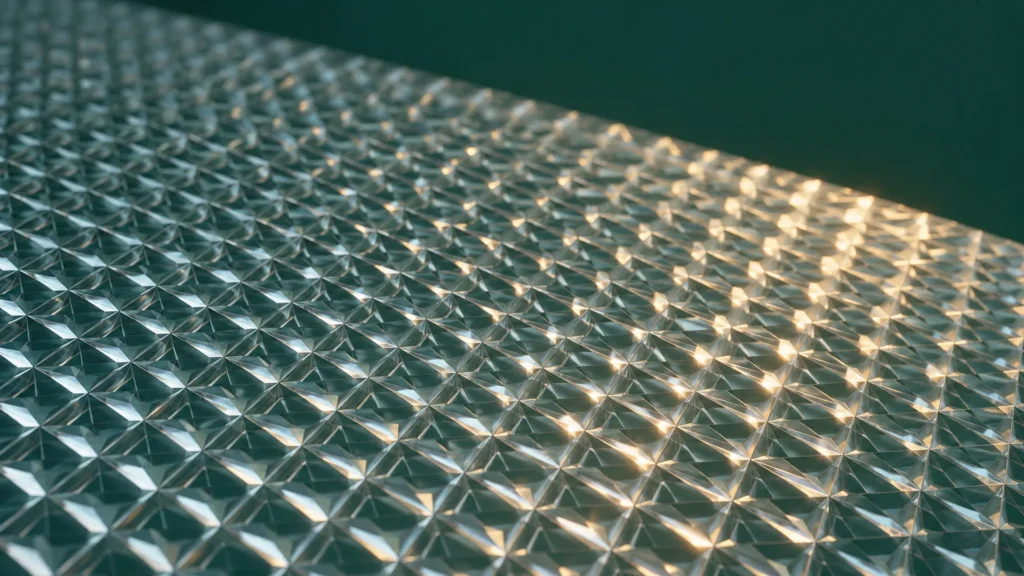
What distinguishes it from a plain sheet is the face. Instead of one flat surface, the panel carries a repeating pattern of angled facets. Because those facets sit at different angles to one another, light arriving at the sheet leaves it in more than one direction, and the surface reads as faceted and alive rather than flat and even. That is a description of how the geometry behaves, not a measured optical figure — and this page does not state one.
What is deliberately not claimed here
The product record describes this item as multi-UV sheeting whose grade designation states the profile, colour, light transmission and additional properties. That tells you the grade code carries those values; it does not tell you which values apply to the grade you will be quoted. So no light-transmission percentage, beam angle, glare rating or diffusion figure appears anywhere on this page, and the name “Prism” is not treated as proof of any optical performance. If your specification needs those numbers, ask for the datasheet for the grade being quoted.
For the same reason the page does not state whether the sheet is solid through its thickness or built with an internal structure. That is a property of the grade supplied, it changes how the panel is fixed and edge-finished, and it is listed below as something to confirm rather than guessed at here.
How it differs from a smooth sheet
A smooth sheet presents one continuous plane, so what you see through it stays coherent and what you see on it is an even reflection. A prism-patterned face does neither. The repeating facets break both the reflection and the view, which is why this finish gets specified where a panel should read as a designed surface rather than as clear glazing, and why it is not the product to choose when a clean view through matters.
Compared with the other textured sheets in the range, the difference is the pattern itself. The Diamond Sheet carries a larger, more openly geometric pattern. The Embossed Sheet carries a fine, close texture that disappears at a distance. Prism sits between them: a defined repeating tile that stays legible close up and still reads as a pattern across a whole panel.
Settle these before ordering
- The thickness, chosen against the span, the support spacing and the loads the panel will carry.
- The width, so the supports suit the panel rather than the panel being forced onto an existing grid.
- The colour, viewed as a physical sample in the light the panel will sit in.
- The sheet length your run needs, and the quantity.
- Which face carries the specified UV protection, and that it will face outward.
- Whether the grade suits the exposure — indoors, sheltered or fully weather-exposed.
General polycarbonate behaviour is described above. Measured performance for the grade quoted to you is issued on the technical datasheet and is not asserted on this page.
How the prism pattern is put together
The drawing below names the parts of the pattern and what each one does. The tile size, the facet angle and the depth are drawn for clarity — they are not measured dimensions for this product.
What the pattern does
Two things follow from facets pointing in different directions. The first is visual: reflections land in several directions at once, so the panel has depth and movement as the light or the viewer moves, instead of showing one flat highlight. The second is that what sits behind the panel is broken up rather than framed cleanly. How strongly either effect shows depends on the colour, the thickness and which side is better lit.
Whether that amounts to screening in your situation is a judgement to make with a sample in the actual setting, at the actual viewing distance. This page does not claim privacy, and it does not claim glare control or a diffusion figure, because neither has an approved number behind it for this product.
What is not drawn, and why
You will not find an edge view or a cut section on this page. Drawing one would mean asserting whether the sheet is solid through its thickness or carries an internal structure, and that is not confirmed for this product. Showing it either way would be a guess in a drawing, which is worse than leaving it out.
You will also not find a ray diagram showing light being bent at particular angles. A diagram like that implies measured optical behaviour. Without a datasheet to draw it from, it would be decoration dressed up as engineering. Ask us for the grade’s datasheet and use the figures in it.
What the prism finish gives you
Each of these follows either from the material or from the shape of the surface. None of them is a tested performance figure — where a number has to go into a calculation, ask for the datasheet for the grade quoted.
Polycarbonate is a tough material, and that is the honest limit of what this page claims for it. Impact behaviour, fire classification, scratch resistance and outdoor weathering for the grade quoted are datasheet matters, confirmed per order rather than asserted here.
The published finishes
Pick a finish to update the drawn preview and the enquiry summary. Whatever you select here is carried into the enquiry form at the bottom of this page.
- Product
- Prism Sheet · VL-PC-PR
- Finish
- Clear
- Thickness
- 4 mm, 6 mm, 8 mm and 10 mm
- Widths
- 1220 mm and 2100 mm
Screen colours are illustrative and shift between displays, so treat this as an indication of tint rather than a colour standard. Ask for a physical sample and view it in the light the panel will actually sit in. No light-transmission or heat figure is implied by any tint shown here.
What is confirmed, and what is still to confirm
Three groups, kept apart on purpose. The first is commercial information you can order against. The second lists what this page does not publish, and why. The third is what your engineer decides.
Group 1 · Commercial options Confirmed
| Product | V-LITE® Polycarbonate Prism Sheet |
|---|---|
| Product code | VL-PC-PR |
| Surface | Repeating prism pattern worked into the face |
| Thickness | 4 mm, 6 mm, 8 mm and 10 mm |
| Widths | 1220 mm and 2100 mm |
| Colours | Bronze, Clear and Milky |
| Sheet length | Made to your requirement Practical limits to confirm |
| Construction | Stated by grade designation Solid or structured — to confirm |
| UV protection | Carried in the grade designation Protected face or faces to confirm |
| Packaging | Confirm the protective packaging for your order To confirm |
| Minimum order | Confirm the production minimum for your thickness and colour To confirm |
| Manufacturer | Adinath Poly Plast Pvt. Ltd., Indore, Madhya Pradesh |
Thickness, width and colour are taken from the published product record. Everything marked “to confirm” is marked that way because no approved value for it was available when this page was written — it is not an omission to be filled in by assumption. Tell us the application and we will confirm each one in writing for your order.
Group 2 · Performance data Awaiting datasheet
No tested performance figure for this product is asserted anywhere on this page. Light transmission, beam angle, glare rating, diffusion, thermal transmittance, sound reduction, impact behaviour, fire classification, permissible span, load capacity, minimum bend radius, weight and warranty are not published here, for one reason: those figures have to come from an approved product datasheet, and that is the document to specify against rather than a web page.
- The product record states that the grade designation carries the profile, colour, light transmission and additional properties. It does not state which values belong to a given grade, so none are reproduced here.
- The name “Prism” is not evidence of a particular optical performance. Whether this product is intended primarily for architectural glazing, decorative use or light diffusion is itself on the confirmation list.
- Company management-system certifications — ISO 9001, ISO 14001, ISO 45001 and the ZED Gold rating — describe how the plant is run. They are held at company level and are not a product test approval for this or any other item.
Group 3 · What your engineer decides
Thickness against span, support spacing, fixing centres, hole sizing for thermal movement, slope and drainage, and the sealing detail at every joint and upstand are project engineering for the actual structure. Nothing on this page substitutes for that, and no structural approval is claimed. Send us the span, the loads and the location and we will tell you what we can supply against them.
Where it is considered, and what to check first
For each use: the requirement, what the prism face contributes, and the point that still has to be settled. The third column is the one that gets skipped, and it is the one that causes problems on site.

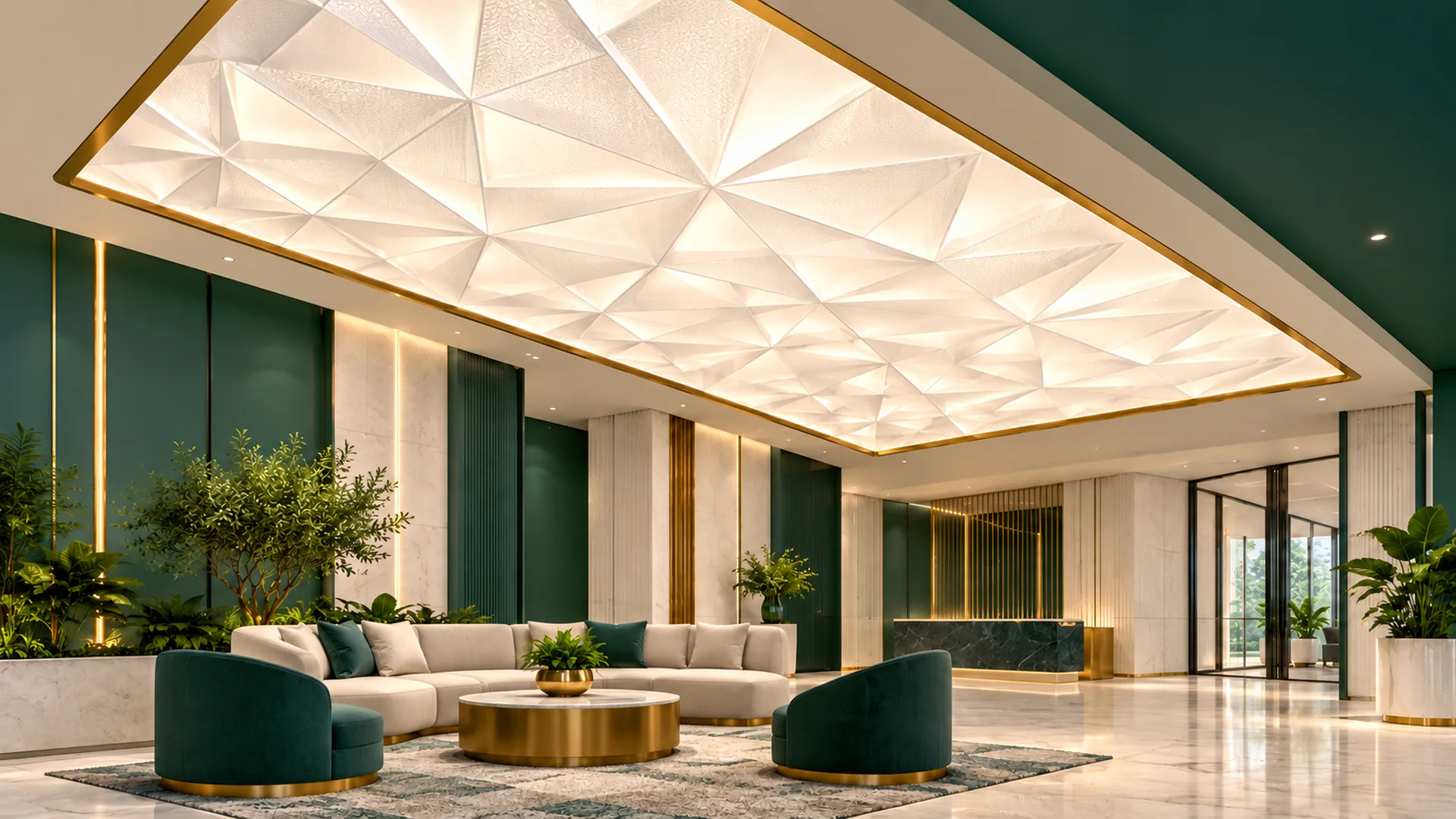
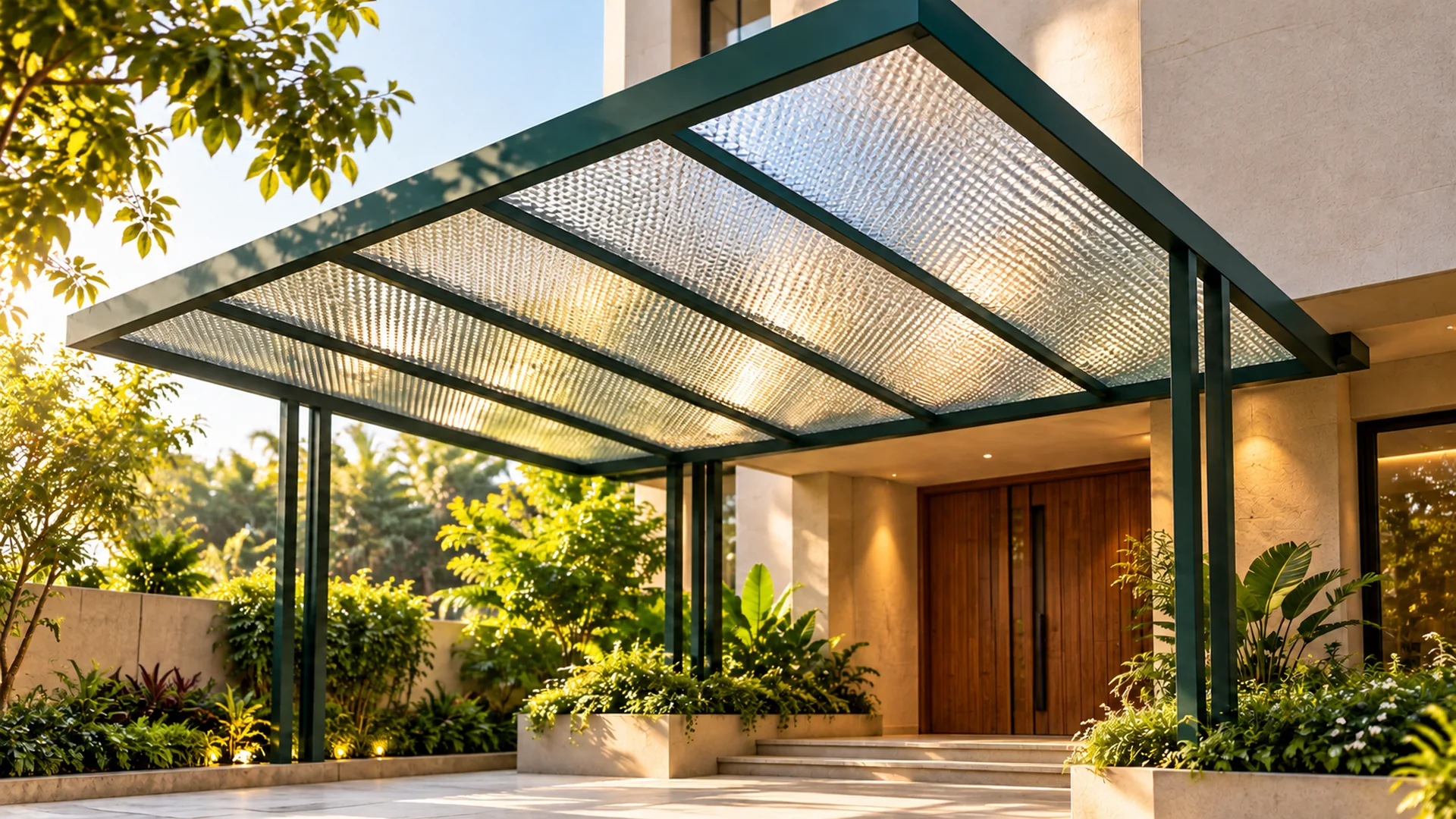
Original AI-generated application concepts, not completed V-LITE installations. Exact surface appearance varies by grade.
| Application | The requirement | What the finish contributes | Still to confirm |
|---|---|---|---|
| Decorative partitions and screens | Light shared between two spaces without a clear view straight through. | The faceted face breaks up what is behind it and gives the panel a designed surface, so no applied film or blind is needed to make it read as a divider. | Whether the degree of screening is enough at the real viewing distance and lighting — assess a physical sample in place before committing. |
| Interior feature panels and ceilings | A surface that carries visual interest in its own right. | The repeating tile gives depth and movement that a plain panel cannot, which is the main reason this finish gets specified for feature work. | Colour consistency across the quantity ordered, the fixing system, and how the panel is reached for cleaning. |
| Entrance canopies and covered walkways | A sheltered entrance or route that still reads as designed rather than purely functional. | Light arrives broken up rather than as a clear view of the sky, and the faceted surface catches light from several angles along the run. | Confirm the grade suits the exposure, then settle thickness against span and wind load, fixing centres with room for movement, and the sealing detail where the canopy meets the building. |
| Architectural glazing elements | Glazed infill where a panel should read as a surface rather than as a window. | A glowing, patterned panel instead of a transparent one, with the pattern staying legible both close up and across a whole elevation. | Whether a glazing-grade product is required instead, any safety-glazing or regulatory requirement for the location, and the framing system the panel sits in. |
| Selected rooflight work | A roofed element where appearance matters as much as cover. | Breaks up direct light arriving through the roof and gives the soffit a more even look from below. | This is the application needing most care: spans, wind and live loads, slope, drainage, laps and seals all decide both the thickness and whether this product suits the job at all. Confirm the grade is specified for external use before it is considered. |
| Lighting diffusers | A panel in front of a light source, to spread what comes through it. | Faceted surfaces are commonly used for this, which is why the application is listed — but suitability here depends entirely on the optical figures for the grade. | Do not specify this product as a diffuser on the strength of its name. Ask for the datasheet and confirm the transmission and diffusion values, the temperature the fitting runs at, and any fire requirement for the luminaire. |
This is where the finish is commonly considered, not a statement that it suits every one of these uses. Several of them depend on figures this page does not publish, and on whether the product is specified for interior or exterior use — both of which are on the confirmation list. Final suitability depends on the grade supplied and on project engineering. Browse applications across the V-LITE range.
A visual guide to the prism finish
Explore the surface pattern, panel layout, published options and texture comparison. Select an illustration to enlarge it. These diagrams explain the design; they do not state tested performance.
The repeating tile and the facets inside it, with the parts named. Tile size, facet angle and depth are schematic.
How one tile reads against a whole sheet, so the scale of the pattern can be judged at panel size.
Every published option drawn from the product record. Thickness and width are on their own separate scales.
The three textured faces at the same scale. Appearance only — no performance figure and no construction claim.
From an idea to an order
Use this sequence to turn an application brief into a clear, comparable quotation.
- Application
Tell us where the panel will be used and whether it is indoors or exposed.
- Grade & sample
Confirm construction, UV specification and the finish with the quoted grade.
- Dimensions
Share width, length, support spacing and the required quantity.
- Order & delivery
Agree packaging, freight, payment and timing in the written quotation.
Illustrations are schematic. Confirm the exact surface, construction and suitability using the supplied grade information and a physical sample.
Choosing it, fitting it, keeping it
What to decide before ordering, and what the approved instructions — not this page — have to tell you before anything is fixed.
Choosing the right panel
Work through it in this order. Start with the application and the exposure: interior feature work, a sheltered canopy and a fully weather-exposed roof are three different specifications, and the grade has to be confirmed for the one you are in. Then the dimensions — the width that suits your support grid and the sheet length your run needs. Then the thickness, which follows from the span, the support spacing and the loads rather than from how the panel looks. Then the colour, judged from a physical sample in the real light. Finally the appearance you are after: how strongly you want the pattern to read, and from what distance it will be seen.
Before anything is fixed
Confirm which face carries the specified UV protection and install it outward. That single detail cannot be corrected after the panel is up, and on a UV-protected sheet it is the difference between a panel that lasts and one that does not. Keep the pattern direction consistent across adjacent panels if the tile is meant to line up across a run — decide that at setting-out, not halfway through fixing.
Movement, fixing and accessories
Polycarbonate moves with temperature, so fixing holes are oversized and a run needs room at its ends. This page does not give you the figures: expansion allowance, hole sizing, fixing centres, insertion depth and minimum slope all come from the approved instructions for the grade and system supplied, and reusing a figure from another product is how installations fail. Ask us for the instructions that apply to your order.
Profiles, gaskets, tapes, sealants and screws must be compatible with polycarbonate — incompatible sealants and solvents can craze the material, which shows up as fine cracks months later. Our H jointers, U clips, EPDM gaskets, washered screws and silicone sealant are supplied for this work.
Handling and cleaning
Keep sheets flat, off the ground, under cover and out of standing water, and lift rather than drag them — grit between two faces is the commonest cause of surface marking before a panel is even installed, and a faceted face shows handling marks differently from a flat one. Remove the protective film as soon as the panel is installed; film left in sunlight becomes far harder to remove. Clean with lukewarm water, a mild detergent and a soft cloth. No abrasives, no scrapers and no solvent cleaners.
A sheet that sheds water is not the same thing as a weather-tight roof. Whether a finished installation stays dry is decided by the joints, laps, closures, seals, slope and supports around the panel, all of which are installation and engineering matters.
Packaging, freight and order support
You are buying directly from the manufacturer, not through a marketplace. There is no escrow, no platform payment guarantee, no automatic refund mechanism and no platform-managed logistics — anything agreed is agreed directly with Adinath Poly Plast Pvt. Ltd., in writing, before production starts.
Packaging
Ask us to confirm how your order will be packed and protected before dispatch. The arrangement depends on the thickness, the width and the length of the run, and a faceted face needs its protective film treated with more care than a flat one, so it is worth settling in writing rather than assuming. No packaging specification is published on this page because none was confirmed for this product when it was written.
Freight and timing
Freight is quoted per order rather than published as a rate, because it depends on the destination, the quantity, the sheet length, the space the load occupies and whether we arrange transport or you send your own vehicle. Keep three things separate when planning: production lead time, dispatch from our plant in Indore, Madhya Pradesh, and transit to your site. Ask us to confirm all three. Any schedule given before that confirmation is indicative, not a delivery guarantee.
Payment and confirmation
Payment terms, accepted methods and any advance are agreed in writing on the quotation and order confirmation for each order. Treat that written confirmation, not this page, as the record of what has been agreed. No standing payment schedule is published here and no payment method is listed that we have not confirmed we accept.
Inspection and documentation
Ask at the enquiry stage what documentation can be issued with your order and whether an inspection can be arranged for it. We would rather confirm what is genuinely available for your specification than advertise a service that may not apply to every order. Warranty scope and its conditions are confirmed the same way, on the quotation.
After-sales
If something arrives damaged or does not match what was confirmed, contact us with the order reference, photographs and the batch reference from the dispatch, before the material is installed. Reporting early makes it far easier to establish what happened and put it right.
Before you specify
Twelve questions buyers ask before placing an order. Every answer is in the page itself, so it is readable without opening anything.
What is a Polycarbonate Prism Sheet?
It is a polycarbonate sheet supplied with a repeating prism pattern worked into its face. Instead of one flat plane, the surface carries tiles divided into facets that sit at different angles, so light reaching the sheet leaves it in several directions and the panel reads as faceted rather than flat. It is ordered against product code VL-PC-PR.
What creates the prism surface appearance?
The geometry of the face. Each repeating tile is divided into facets, and because adjacent facets point in different directions they catch and return light differently. That is what produces the depth and movement you see as the light or your viewpoint changes. The tile size, facet angle and depth for the grade supplied come from the datasheet; the drawing on this page is schematic.
How does it differ from Diamond or Embossed Sheet?
By pattern. Diamond carries a larger, more openly geometric pattern. Embossed carries a fine, close texture that tends to disappear at a distance. Prism sits between them — a defined repeating tile that stays legible close up and still reads as a pattern across a whole panel. The comparison on this page is of appearance only; it makes no performance or construction claim about any of the three.
Which thicknesses and dimensions are available?
Published thicknesses are 4 mm, 6 mm, 8 mm and 10 mm and published widths are 1220 mm and 2100 mm. Sheet length is made to your requirement rather than being unlimited — the practical maximum depends on the thickness, the width, how the load packs and how it can reach your site, so ask us to confirm it for your order.
Which colours can be ordered?
The published finishes are Bronze, Clear and Milky. Screen colours are approximate, so ask for a physical sample and view it in the light the panel will actually sit in before committing. No light or heat figure is implied by any tint.
Does it have UV protection?
The grade designation for V-LITE sheeting carries its UV specification, so UV protection is defined per grade rather than as a single claim for the product. Confirm with your quotation which face is the specified protected face and whether one or both faces are protected — and make sure the protected face is installed outward, because that cannot be corrected afterwards.
Is it suitable for outdoor use?
That depends on the grade, and it has to be confirmed rather than assumed. Interior feature work, a sheltered canopy and a fully weather-exposed roof are three different specifications. Tell us the exposure the panel will see and we will confirm whether the grade is specified for it, along with the thickness your span and loads call for.
Can it be used for lighting applications?
Faceted surfaces are commonly used in front of light sources, which is why the application is listed on this page — but do not specify this product as a diffuser on the strength of its name. Ask for the datasheet and confirm the transmission and diffusion values for the grade, the temperature the fitting runs at, and any fire requirement that applies to the luminaire.
Does the texture provide privacy?
The pattern breaks up what is behind the panel, so shapes read as indistinct rather than clearly. Whether that amounts to privacy in your situation depends on the colour, the thickness, the viewing distance and which side is better lit, so this page does not claim privacy as a property. Assess a physical sample in the actual setting before relying on it.
How should it be cleaned?
Lukewarm water, a mild detergent and a soft cloth. No abrasives, no scrapers and no solvent cleaners — those can craze polycarbonate, which appears as fine cracks months later. A faceted face holds dust differently from a flat one, so rinse first rather than wiping dry grit across the surface. Remove the protective film as soon as the panel is installed.
What affects the price?
Thickness, colour, width, the length of your run, total quantity against the production minimum, the accessories specified with it, and freight to your location. There is no published rate card because those variables change the figure. Send us the specification and we will quote against it in writing.
What information is required for a quotation?
Application and delivery location; the thickness you need, or the span and support spacing so we can recommend one; finish; required sheet dimensions; quantity and the unit you are working in; and anything about the supporting structure or the programme that affects the specification. The enquiry form on this page collects exactly that, and whatever you select in the finish explorer is carried into it.
Ask for a quotation
Tell us what the panel has to do. If you are unsure of the thickness, send the span and support spacing instead and we will recommend one. Anything you selected in the finish explorer is already filled in below.
Your enquiry reaches the V-LITE sales desk through the same system as every other enquiry on this website. We will confirm the grade, its construction and UV specification, the exposure it is approved for, the supply format for your length, freight and the schedule in writing before anything is produced.
Made at our own plant in Indore.
V-LITE® is manufactured by Adinath Poly Plast Pvt. Ltd. — extrusion, cutting, masking, testing and packing all under one roof, with batch traceability on every dispatch.