V-LITE® Polycarbonate Embossed Sheet
V-LITE® polycarbonate embossed sheet features a fine textured face that diffuses daylight and helps soften glare. Specify colour, thickness and UV protection for your project.
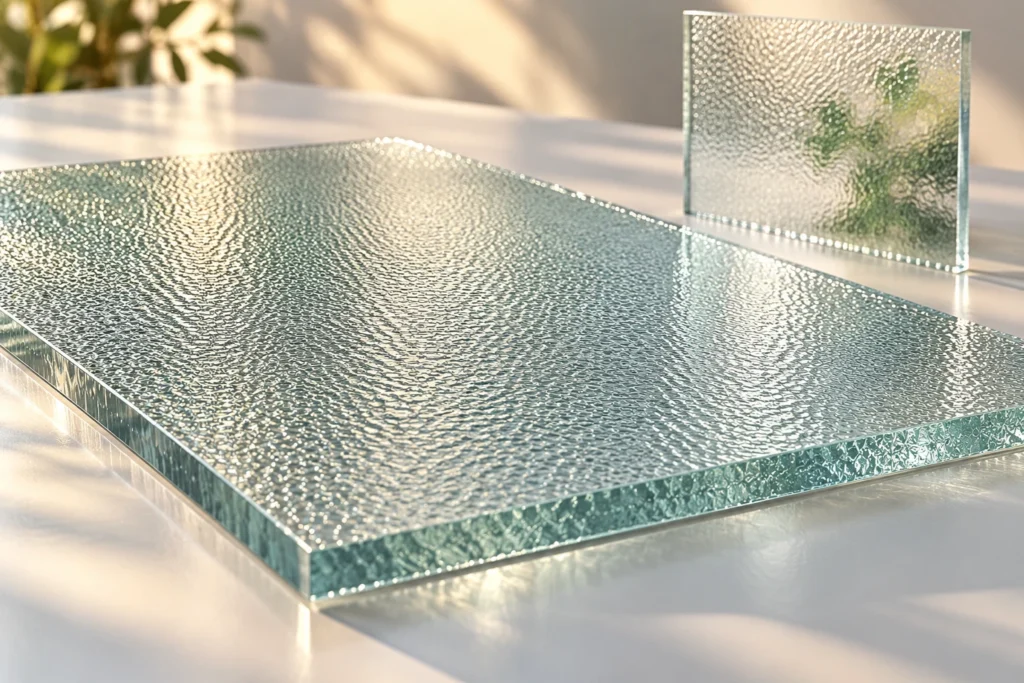 Product visualisation · exact finish may vary
Texture that changes the light.
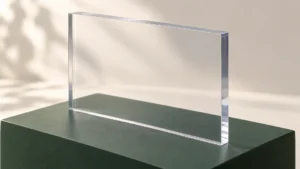
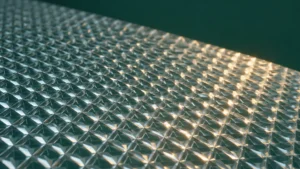
A solid polycarbonate sheet with a finely embossed face. It spreads transmitted daylight and softens the view through the panel.
Choose the colour, thickness and UV protection to suit your project.
View specifications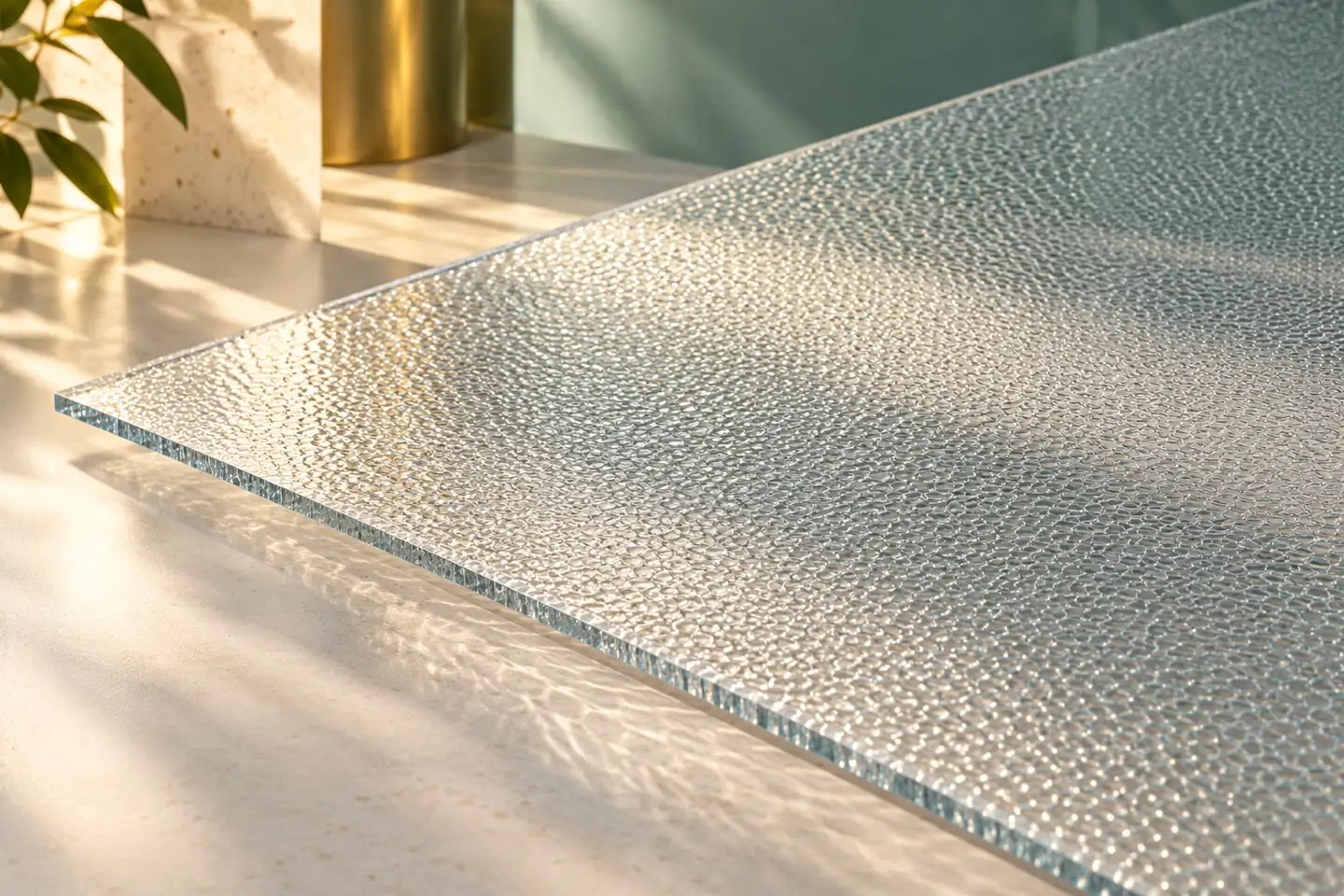
Choose by what your project needs
What this sheet is built to do.
V-LITE® polycarbonate embossed sheet has a finely textured surface that diffuses incoming daylight and helps soften glare while making everyday surface marks less prominent. The embossed finish is considered for skylights, roof lights, covered walkways, partitions and decorative glazing where softened daylight or added privacy is desired.
Choose from the available thickness and colour options for your application. UV protection is available on one or both sides. Confirm the grade, dimensions, light transmission, support spacing and installation details with the V-LITE team before ordering.
See the embossed profile in context.
Rotate the embossed sheet and preview it on a sample roof structure. This is an illustrative visualisation; the thickness, colours and cut length available for quotation are listed in the product specifications below.
Choose a finish and application.
Change the finish, thickness and roof setting in the controls. The view is illustrative; confirm supply details and product performance against your quotation and datasheet.
Static product previewInteractive 3D is unavailable in this browser. Product options and enquiry tools remain available.
Product type
Colour
Clear#EFF6F5Requested thickness
Sheet size
Structure / application
Industrial & CommercialQuantity
- Product
- Embossed Sheet
- Colour
- Clear
- Thickness
- 2 – 6 mm
- Size
- 1220 mm wide, cut to length
- Light transmission
- Confirm by grade
- Application
- Illustrative preview
Inquiry list: 0 items
Nothing added yet. Configure a sheet and press “Add to inquiry”.
4 finishes, one geometry.
Choose Bronze, Clear, Green, Milky. Ask our team to confirm the suitable grade and UV protection for your project.
Compare the finish. Preview the colour.
Explore how the face changes the view, then preview the four published tints in a simple canopy illustration.
Smooth face or embossed face?
Concept illustration. Screening depends on tint, viewing distance and lighting; this is not a tested privacy rating.
The same canopy, four tints
Illustrative tint only. Confirm actual appearance and light transmission with a sample and the quoted-grade datasheet.
A solid polycarbonate sheet with a textured face
The V-LITE® Polycarbonate Embossed Sheet is a solid polycarbonate sheet whose face carries a fine repeating texture instead of a flat polished finish. That texture breaks up light as it passes through, so daylight arrives spread across a space rather than as a hard-edged bright patch, and shapes behind the sheet read as softened outlines. It is specified for skylights and roof lights, walkway canopies, interior partitions, decorative glazing and selected greenhouse projects — wherever daylight is wanted but a clear view through is not.
Quick reference
What this product is and how it is supplied. The fuller technical table is further down.
| Brand | V-LITE® |
|---|---|
| Manufacturer | Adinath Poly Plast Pvt. Ltd., established 2009 |
| Manufacturing location | Indore, Madhya Pradesh, India |
| Product category | Polycarbonate sheets |
| Product code | VL-PC-EM |
| Finish | Embossed — a repeating surface texture on a solid sheet |
| Thickness options | 2 mm, 3 mm, 4 mm, 5 mm and 6 mm |
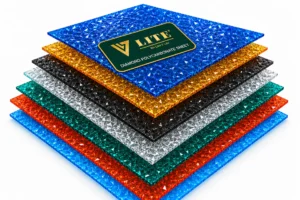
| Colour options | Bronze, Clear, Green and Milky |
| Width | 1220 mm |
| Length | Cut to length against the order |
| UV protection | One face or both faces, as specified on the order |
| Surface protection | PE protective film on both faces |
These are the published options. If your project needs a thickness, width or finish outside this list, ask whether it can be produced rather than assuming it can.
Shipping Cost
Freight is quoted per order rather than published as a fixed rate, because the cost of moving polycarbonate sheet changes with the destination, the quantity, the cut length and the space the load occupies, whether the material is being produced or drawn from available stock, and whether we arrange transport or you send your own vehicle.
Keep three things apart when planning a site programme. Production lead time is how long the material takes to be made once the order is confirmed. Dispatch is when the finished material leaves our plant in Indore. Transit is how long the vehicle then takes to reach you. Ask us to confirm all three for your order rather than working from a single headline figure that hides the difference.
Send your city and postal code with the quantity and cut length, and we will come back with the freight position for that destination. Request a delivered quotation.
Ordering, payment and buyer support
You are buying directly from the manufacturer, not through a marketplace — so the terms below are ours to agree with you directly, in writing, before anything is produced.
Payment terms and order confirmation
Payment terms, accepted methods and any advance are agreed in writing on the quotation and order confirmation for each order. Treat that written confirmation, not this page, as the record of what has been agreed; we publish no standing payment schedule here.
Dispatch and shipment coordination
Once your order is confirmed we will tell you when the material is scheduled to be ready and how it is planned to travel. If you are arranging your own vehicle, say so at the order stage so loading can be coordinated.
Inspection and quality documentation
Ask at the enquiry stage what documentation can be issued with your order, and whether an inspection can be arranged for it. We would rather confirm what is genuinely available for your specification than list a service that may not apply to every order.
After-sales support and complaint handling
If something arrives damaged or does not match what was confirmed, contact us with the order reference, photographs and the batch reference from the dispatch. Reporting early — before the material is installed or the film removed — makes it far easier to establish what happened and put it right.
This is a manufacturer-direct website. There is no escrow, no platform payment guarantee, no automatic refund mechanism, no platform-managed logistics and no platform-assisted dispute process. Anything agreed is agreed directly with Adinath Poly Plast Pvt. Ltd.
- Send the specification
Application, thickness, colour, cut length and quantity.
- Confirm the order
Agree the grade, UV protection, written terms and freight.
- Plan the delivery
Confirm production, dispatch and transit separately.
Packaging, handling and delivery
Sheets leave the plant with a PE protective film on both faces. The film protects the surface in transit and on site, and it carries the marking that identifies the UV-protected face. Keep it on while the sheet is handled, cut and fixed, and peel it off once the sheet is installed — film left on a fixed sheet through long sun exposure becomes harder to remove cleanly.
On site, store sheets flat, clear of the ground, under cover and out of standing water, with nothing heavy or sharp stacked on top. Lift rather than drag: grit trapped between two faces is the commonest cause of surface marking before a panel is even installed.
Check the load against the dispatch documents while the vehicle is still with you. If anything is short, damaged or not what was confirmed, photograph it before unloading finishes and tell us with the batch reference. Claim deadlines and insurance terms are confirmed per order rather than published here — ask what applies to yours.
What the texture actually does
It spreads the light that comes through
A polished face lets a beam carry on roughly as it arrived, which is why a smooth clear panel throws a sharp bright rectangle on the floor. A textured face redirects that light across a range of angles instead, so it lands spread over a wider area: a more even pool of daylight and a less obvious hot spot. That is not the elimination of glare, which also depends on sun angle, tint, opening size and what the light falls on.
It screens a view, by degree
Shapes behind the sheet read as softened outlines rather than sharp detail. How much is obscured depends on the colour specified, viewing distance and which side is better lit. Treat it as screening you can tune, not as a privacy panel.
It changes how the panel looks
The texture gives the surface depth and movement in changing light, which is why the finish is chosen for feature glazing and partitions where a flat panel looks plain. Everyday marks and smudges also tend to read as less prominent than on a polished face — an appearance benefit, not a scratch-resistant or scratch-proof coating.
UV protection is specified, not assumed
UV protection is available on one face or both. It is applied during manufacture and identified on the protective film, so it is something to specify on the order and check on delivery rather than take for granted.
What an embossed polycarbonate sheet is
A polycarbonate embossed sheet is a solid polycarbonate sheet given a repeating pattern of fine raised and lowered detail across its face during manufacture. The sheet itself is continuous material from one face to the other: nothing is hollowed out and no internal cells or channels are formed. Everything that separates it from a plain sheet happens at the surface.
That distinction matters, because “embossed sheet” appears in listings alongside “honeycomb” and “multiwall”, which describe something different — a hollow panel with two or more skins held apart by internal ribs. Multiwall behaves differently in nearly everything a specifier cares about: weight, stiffness for a given depth, edge sealing, fixing and insulation. If a drawing calls for a multiwall or honeycomb panel, this is not that product; our V-LITE Polycarbonate Multiwall Sheet is. If it calls for a flat, clear, unbroken view, the Solid Compact Sheet is the closer match.
Against a smooth compact sheet of the same thickness, the difference is in the light and the view, not the bulk of the sheet. A smooth panel reads as a window; an embossed panel reads as a lit surface — brightness without a clear view through it.
How much privacy it actually gives
Privacy here is a matter of degree, moved by four things: the tint, how coarse the texture is, how far away the viewer stands, and which side has more light on it. A darker tint at a distance obscures a great deal; a clear sheet at arm's length in a bright room obscures much less. Where a project has a defined privacy requirement, assess a physical sample in conditions close to the real ones.
The finish is worth considering where daylight should arrive softened and evenly spread, where a flat panel would look too plain, or where a view straight through is not wanted. Before ordering, settle five things: thickness and colour, UV protection on one face or both, cut length, the support layout the sheet will sit on, and the performance figures your design must be checked against — which should come from the datasheet for the grade quoted, not from a general description of the material.
Specification
Confirmed supply options, with performance data handled honestly: where a tested figure has not been published for this product, this page asks for the datasheet instead of printing a number.
| Property | Value | Unit or basis |
|---|---|---|
| Material | Polycarbonate | — |
| Construction | Solid sheet, not hollow | — |
| Surface finish | Embossed texture | One face |
| Thickness options | 2 mm, 3 mm, 4 mm, 5 mm and 6 mm | mm |
| Colour options | Bronze, Clear, Green and Milky | — |
| Width | 1220 | mm |
| Length | Cut to order | mm |
| UV protection | One face or both faces | As ordered |
| Protective film | PE film on both faces | — |
| Product code | VL-PC-EM | — |
| Manufacturer | Adinath Poly Plast Pvt. Ltd., Indore | — |
| Management systems | ISO 9001, ISO 14001, ISO 45001; ZED Gold (MSME) | Company-level |
| Performance data | Light transmission, weight per square metre, impact behaviour, service temperature range, fire classification, thermal transmittance, minimum cold bend radius and permissible span are not published on this page. Request the product-specific technical datasheet for the grade quoted. | |
Management-system certifications are held at company level and describe how the plant is run; they are not a performance rating for this product. Any structural check — span, support spacing, wind and live load — is project engineering and must be confirmed for the actual conditions.
Where this finish earns its place
Two things get mixed together in most product copy, so they are separated here: what is true of polycarbonate as a material, and what is specific to choosing an embossed face over a flat one. Only the second is a reason to pick this product, and neither replaces a tested figure for your design.
Daylight that reaches further into the space
The strongest argument for a textured face is distribution. A rooflight glazed with flat clear sheet produces a bright patch that tracks across the floor, bright where it lands and dark elsewhere. Scatter the light at the glazing and you trade peak brightness for coverage. Whether that cuts the hours you run the lights is a question for a daylight calculation on your own building — not for a percentage quoted here.
Screening without blocking the light
Where a panel should pass light but not a view, a textured sheet does both jobs and avoids a second layer of blinds, film or frosting. That is why it suits partitions, stair enclosures, service-area glazing and street-facing panels. How much it screens is application-dependent, so it fits requirements expressed as “we do not want people looking straight through” better than a measured obscuration class.
Design flexibility
4 tints and 5 thicknesses give a usable range, and because length is cut to order, panel sizes can follow the structural grid instead of the other way round. Polycarbonate can generally be cold-curved, but the minimum radius depends on grade and thickness — take that figure from the datasheet before drawing the curve.
Practical handling on site
Polycarbonate is substantially lighter than glass of comparable size, which changes the economics of a job: smaller crews, less lifting plant, lighter supporting structure. It also tolerates impact in a way glass does not. That is a characteristic of the material, not a certification — this page makes no claim that the product is unbreakable, and any safety-glazing or security standard must be verified for the specific grade.
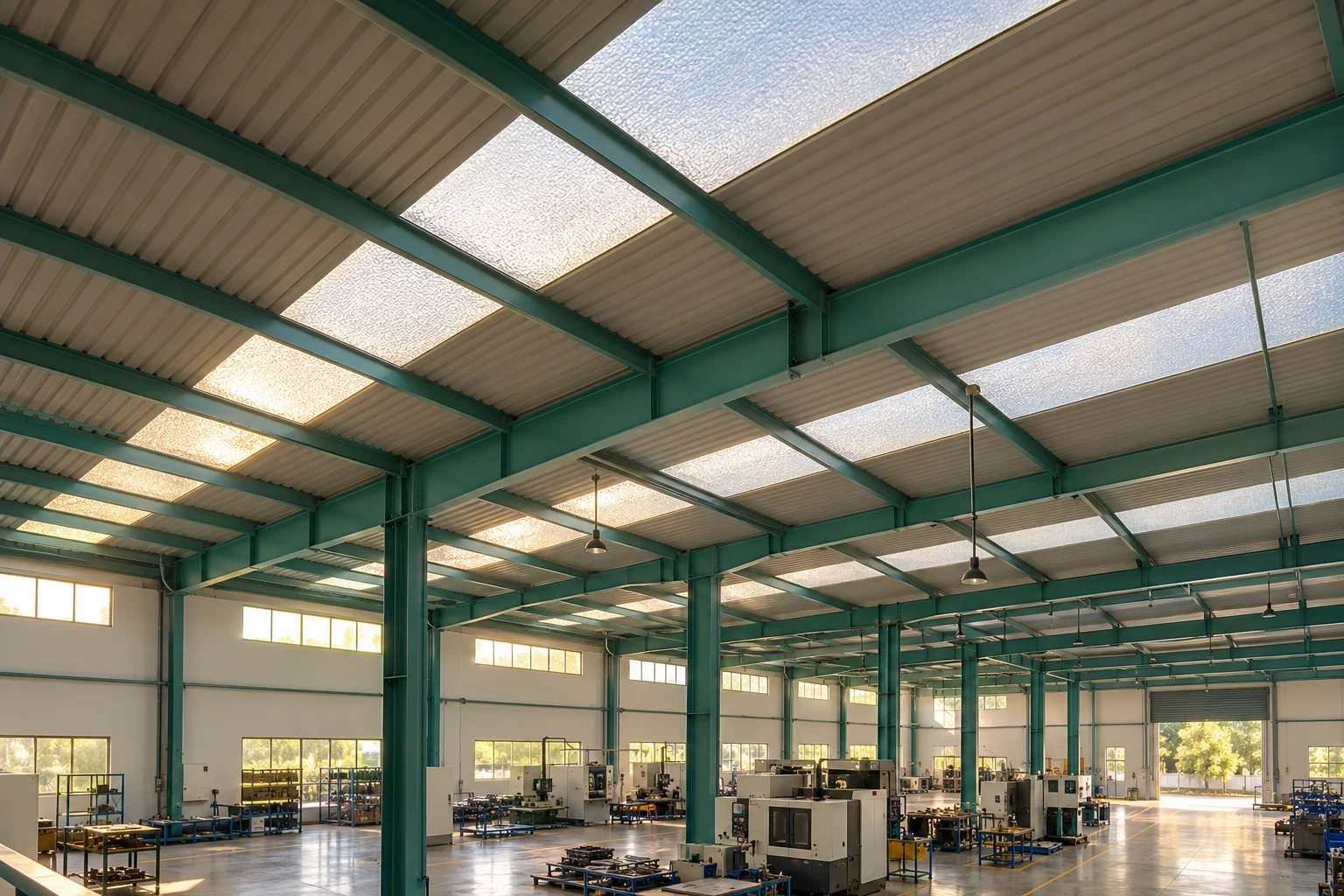
Where it is specified, and what to check first
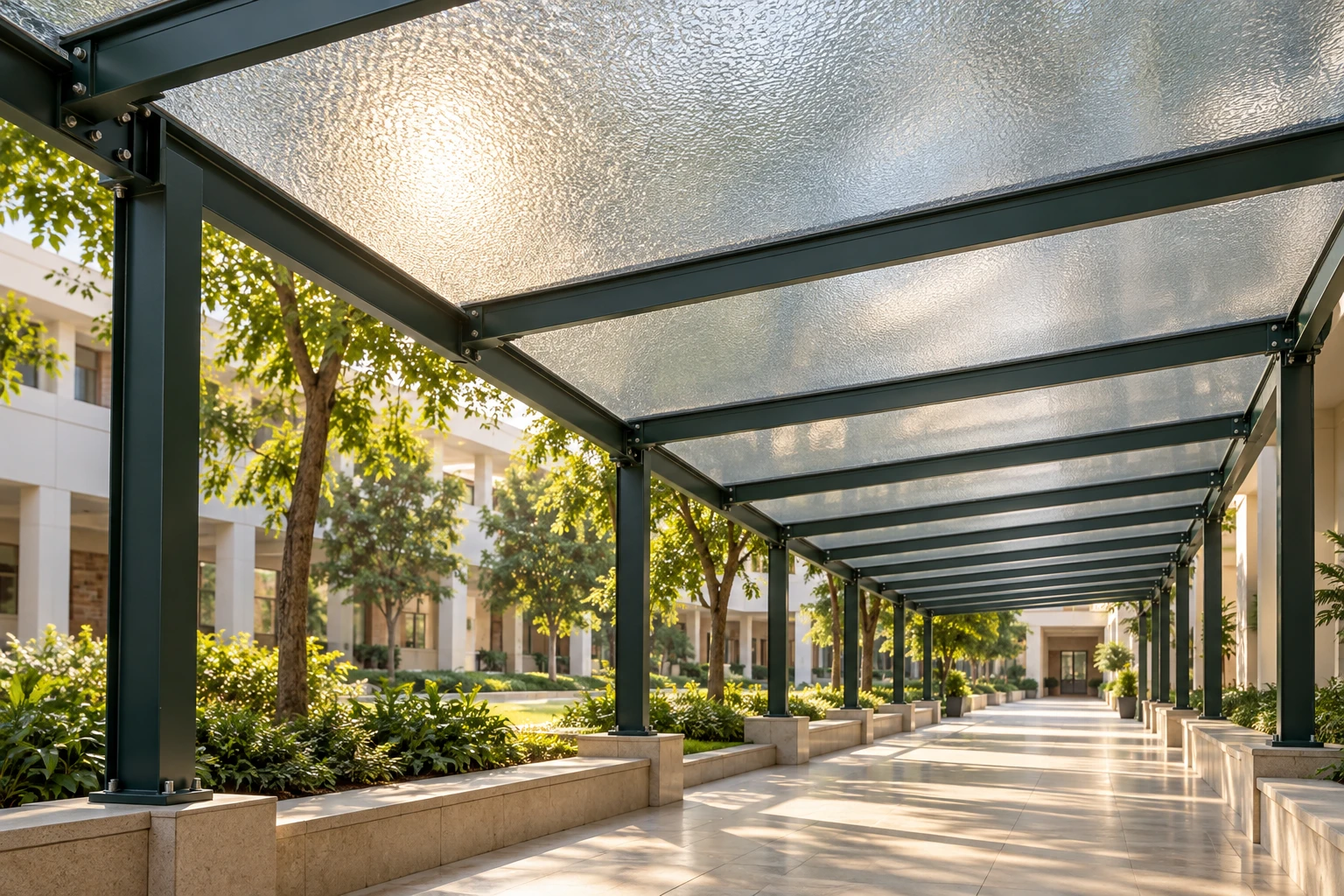

For each use: what the buyer is after, why a textured face helps, and what still has to be checked. The third column is the one that gets skipped, and the one that causes problems on site.
Showing all application options.
| Application | What you are after | Why the texture helps | Still to check |
|---|---|---|---|
| Skylights and roof lights | Daylight into a deep space without a hot spot tracking across the floor. | Spreads transmitted light, so coverage improves and the bright patch softens. | Thickness against span and load, support layout, slope, drainage and the upstand sealing detail — project engineering, not this page. |
| Walkway canopies | A sheltered, daylit route that does not feel like a tunnel. | Softens light along the walkway and the glare of a low sun through clear sheet. | Fixing centres and hole sizing for movement, edge and end details, and the exposure the panel will see. |
| Facades and feature glazing | A panel with surface interest that still reads as glazing. | Texture gives depth and movement in changing light where flat sheet looks plain. | Colour consistency across the quantity ordered, weathering in that orientation, and which face carries UV protection. |
| Interior partitions | Light shared between two spaces without a view straight through. | Shapes read as softened outlines, so no blinds or applied film are needed. | Whether the screening is enough at the real viewing distance and lighting — assess a sample first. |
| Decorative and backlit panels | An even glow rather than visible lamps or bright streaks. | Diffuses light from behind, evening out the source. | Lamp-to-sheet distance, heat build-up in the cavity, and the tint, since colour shifts the transmitted light. |
| Greenhouse and polyhouse glazing | Diffused light across a crop rather than concentrated beams. | Scattered light reaches further down the canopy and reduces direct-beam scorch. | That the grade suits the crop's light requirement and the structure — crop- and design-specific, so check with us and your agronomist. |
This is where the finish is commonly considered, not a statement that it suits every roof, every agricultural building or every safety-glazing requirement. Roofing covers a wide range of spans, loads and exposures, so have the specification checked against the actual structure. Where a profiled roof sheet is needed, see the Embossed Profile Sheet, or browse applications across the V-LITE range.
Choosing, installing and looking after it
Choosing the specification
Work through it in this order. Structure first: span and load decide the thickness, and that is an engineering decision rather than a catalogue one. Then light: how much daylight and how much screening, which together point to the tint. Then exposure: how much sun and weather the panel takes and from which side, which decides UV protection on one face or both. Sizes last, once the support layout is fixed.
If you are choosing between tints, ask for samples and view them in the actual light from the actual distance. Colour and texture behave differently on a bright roof and in an interior partition.
Cleaning and maintenance
Rinse with clean water first to float grit off, wash gently with a mild soap solution and a soft cloth, then rinse again. Never use an abrasive pad, scouring powder or strong solvent, and never dry-wipe a dusty sheet — dragging grit across the face causes most surface damage in service.
Installation points that matter
- Identify the UV-protected face from the marking on the film before fixing anything, and make sure it ends up facing the weather.
- Leave the film on through handling, cutting and fixing; peel it off once the sheet is installed.
- Polycarbonate expands and contracts noticeably with temperature. Holes must be larger than the fastener and set in from the edge so the sheet can move; clamping it rigidly causes distortion and cracking around fixings.
- Use accessories intended for polycarbonate — H jointers, U clips, EPDM gaskets and washered screws.
- Check sealant compatibility before use. Some general-purpose sealants attack polycarbonate; ask which to use with this sheet.
- Support the sheet while cutting and drilling, and keep swarf and offcuts off the finished face.
Hole diameters, edge distances, fastener spacing, roof slopes and permissible spans are deliberately not given here. They come from the approved installation instructions for the grade supplied and from the project engineer. Ask for the installation document with your quotation.
Installation: the checks to make
Identify the UV-protected face
Read the protective-film marking and install the specified protected face toward the weather. Confirm whether your order has one- or two-face protection.
Allow for thermal movement
Use the approved fixing-hole sizes, edge distances, support spacing and compatible accessories for the supplied grade. Do not clamp the sheet rigidly.
Remove film after fixing
Keep protective film on through handling and installation. Remove it once fixing is completed; avoid prolonged sun exposure with film in place.
Clean without scratching
Rinse grit off first, then use mild soap and a soft cloth. Avoid abrasive pads, strong solvents and dry-wiping dust.
Technical resources for your project
Request the documents for the grade you intend to order. Product-specific test values and installation dimensions must come from those documents.
Tested-grade datasheet
Light transmission, impact, fire classification and other performance data.
Request datasheetCurrent catalogue
Ask for the latest supply options and product range.
Request cataloguePlanning checklist
Published options and questions to settle before ordering.
Download checklist (.txt)Installation overview
Review orientation, thermal movement, film removal and cleaning.
View visual guideFrom the V-LITE project archive
Published project photographs across the V-LITE range. These records do not confirm embossed-sheet use; ask our team for the sheet specification and location details.
Questions buyers ask about this sheet
Twelve questions, answered first and qualified second.
What is a polycarbonate embossed sheet?
A solid polycarbonate sheet with a fine repeating texture formed across one face during manufacture. The sheet is continuous material throughout; the texture is a surface finish. It scatters transmitted light, so daylight arrives spread rather than as a sharp beam, and objects behind it read as softened outlines.
How does it differ from smooth solid polycarbonate?
The construction is identical — both are solid. The difference is the face. A smooth sheet is polished and behaves like a window: light carries straight through and the view is clear. An embossed face spreads the light and blurs the view. Choose smooth for a clear view, embossed for light without one.
Is embossed polycarbonate the same as honeycomb sheet?
No. Embossed sheet is solid material with a textured face. Honeycomb and multiwall panels are hollow, with skins held apart by internal ribs, and they behave differently in weight, stiffness, edge sealing, fixing and insulation. If your specification calls for multiwall, see the V-LITE Polycarbonate Multiwall Sheet.
What thickness options does V-LITE offer?
2 mm, 3 mm, 4 mm, 5 mm and 6 mm. Which suits your project depends on the span between supports and the loads carried, so treat it as an engineering decision. Send us the support layout for advice, and have the final selection confirmed by the project engineer.
Which colours are available?
4: Bronze, Clear, Green and Milky. The tint changes the appearance, the character of the light transmitted and how much the panel screens a view. If colour matters to the design, ask for samples and view them in the light the panel will sit in.
Does the textured surface provide privacy?
It gives visual screening by degree, not absolute privacy. Shapes read as softened outlines; how much is obscured depends on the tint, the texture, viewing distance and which side is better lit. Where privacy is a defined requirement, assess a sample in realistic conditions.
Is UV protection available?
Yes, on one face or on both, specified at the order stage. It is applied during manufacture, and the protective film carries the marking identifying the protected face — check it on delivery and make sure that face goes toward the weather. Tell us the exposure and we will advise.
Can it be used for roofing and skylights?
It is specified for skylights, roof lights and canopy glazing. It is not suitable for every roof: spans, wind and live loads, slope, drainage and exposure decide both the thickness and whether this product fits at all. Send us the structure and we will say honestly whether it does. Where a profiled sheet is needed, see the Embossed Profile Sheet.
Can it be used for greenhouse glazing?
It is used in greenhouse and polyhouse projects, because diffused light reaches further down a crop canopy and reduces scorch on exposed leaves. Suitability is crop- and design-specific, so it does not fit every growing setup. Discuss the project with us and with your grower or agronomist before ordering.
What affects the price?
Mainly thickness, colour, total quantity, cut length and whether UV protection is on one face or both. Whether material is produced to order or drawn from stock affects price and timing, and freight is quoted separately against your destination. We publish no rate card for this product — send the specification and quantity. See also how V-LITE pricing works.
How should it be cleaned and maintained?
Rinse with clean water to float grit off, wash gently with a mild soap solution and a soft cloth, then rinse again. Avoid abrasive pads, scouring powders and strong solvents, and never dry-wipe a dusty sheet — dragging grit across the face causes most in-service damage. A textured face holds slightly more dust, so rinse a little more often.
How can buyers obtain a quotation and delivery estimate?
Send the application, the thickness or span to work from, colour, cut length, quantity, whether UV is needed on one face or both, and your delivery city and postal code. Drawings or photographs help. We will return the price, the production and dispatch position for that quantity, and the freight for that destination. Start an enquiry.
Plan the quantity. Send the requirement.
Estimate your sheet count, then send the cut length, finish and delivery location in one enquiry.
01 / PLAN
Sheet quantity calculator
Estimate a rectangular layout using the published 1220 mm sheet width and your chosen cut length.
Enter the dimensions and calculate your layout.
Planning estimate for a rectangular area. Joint allowance and extra sheets are your inputs, not installation recommendations. Cutting is not optimised. Confirm actual dimensions, grade, support spacing and installation details before ordering.
02 / SEND
Quick product enquiry
Tell us the specification and delivery location. Our team will review the requirement.
Made at our own plant in Indore.
V-LITE® is manufactured by Adinath Poly Plast Pvt. Ltd. — extrusion, cutting, masking, testing and packing all under one roof, with batch traceability on every dispatch.
Polycarbonate Sheets
Send us the span, the load and the location.
Share the structure, the span and the location and we will return a specification recommendation with a written quotation.